The Ellipsis/Not Implemented Error In M

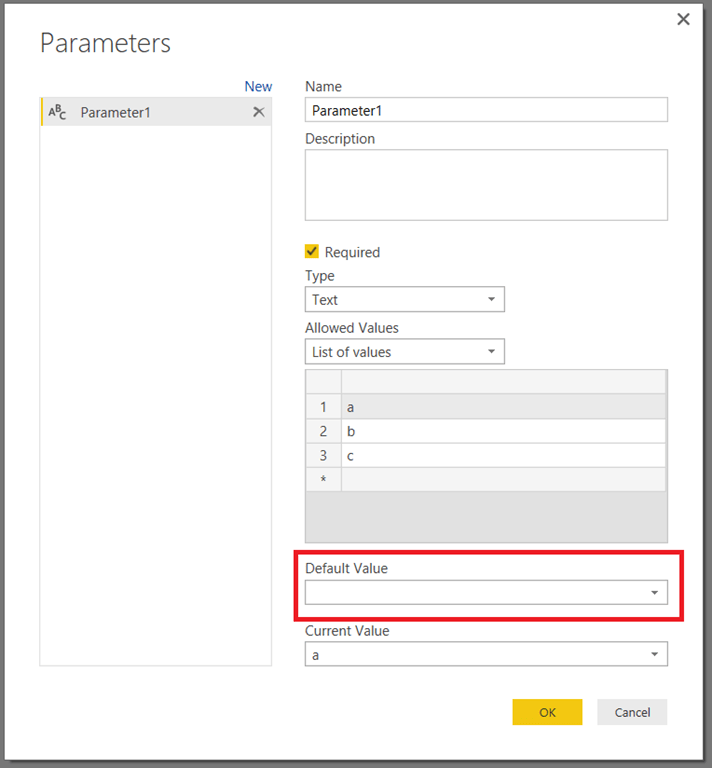
Recently I was creating a parameter in Power BI Desktop and had it configured something like this:

image

I didn’t bother to choose anything in the Default Value dropdown box, and when I looked at the code for the parameter in the Advanced Editor I saw this:

[sourcecode language=”text” padlinenumbers=”true” highlight=”5″]
"a"
meta
[IsParameterQuery=true,
List={"a", "b", "c"},
DefaultValue=…,
Type="Text",
IsParameterQueryRequired=true]
[/sourcecode]

I was interested to know what the ellipsis symbol (three dots …) in the DefaultValue field in the record meant, and looking in the Language Reference I found that in M it can be used for two purposes: as an open record marker (maybe something for a future blog post) and, as in this case, as a quick way of returning an error. The language reference says that it is directly equivalent to the following expression, which returns a “Not Implemented” error:

[sourcecode language=”text”]
error Error.Record("Expression.Error", "Not Implemented")
[/sourcecode]

But from what I can see, it actually returns a “Value was not specified” error instead. Here’s another example of how it can be used in a function definition, and what it returns:

[sourcecode language=”text”]
let
MyFunction = (x,y) => if x>y then true else …,
Output = MyFunction(0,1)
in
Output
[/sourcecode]

image

It’s not something I think I’ll be using in my own code, but it’s good to know what it means!

Creating Sequences Of Integers And Characters In Power BI/Power Query Lists

When you’re writing your own M code you often find yourself needing to create a list containing a sequence of numbers or characters. Luckily the M language allows you to do this very easily when you are defining lists by using expressions in the format

{lowest_integer..highest_integer}

For example, imagine you want to create a list with all of the integers between 1 and 5. Instead of writing

{1, 2, 3, 4, 5}

You can write the following:

{1..5}

and it will return the same list:

image

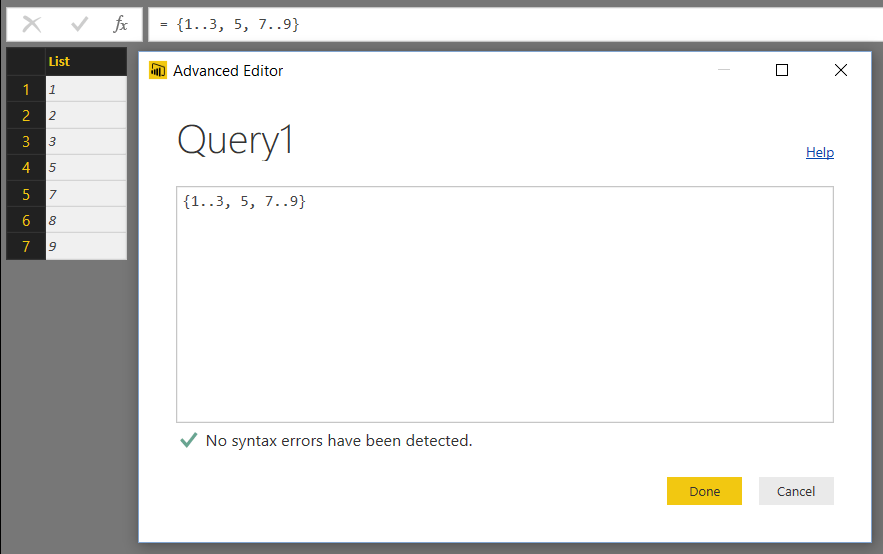
You can also use this format in more complex list definitions, for example

{1..3, 5, 7..9}

Returns the list

{1, 2, 3, 5, 7, 8, 9}

image

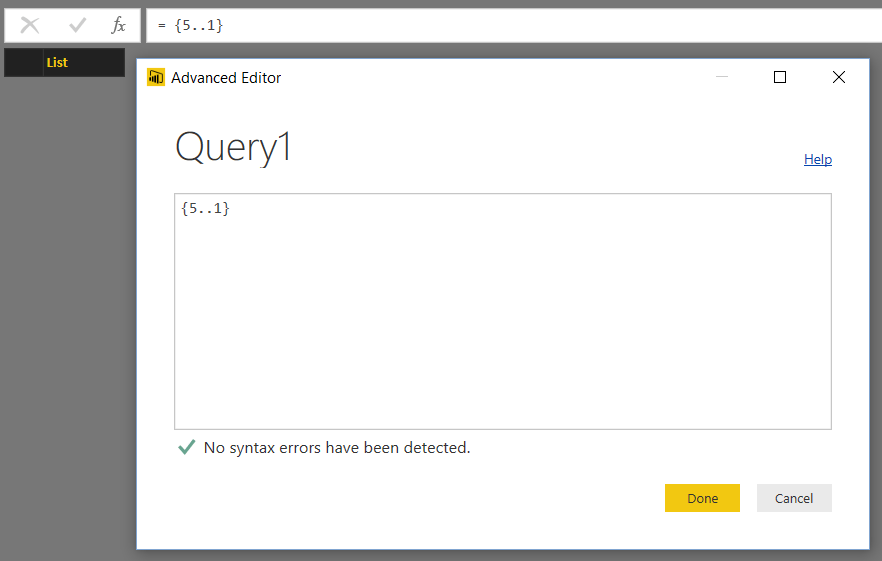
When you’re using this technique you must always put the lowest integer first and the highest integer last; if you don’t do this you get an empty list. So, for example, the expression

{5..1}

Returns an empty list:

image

It’s also possible to use this technique to create lists of characters. For example, the expression:

{"a".."z"}

Returns a list containing all of the lowercase letters of the alphabet:

image

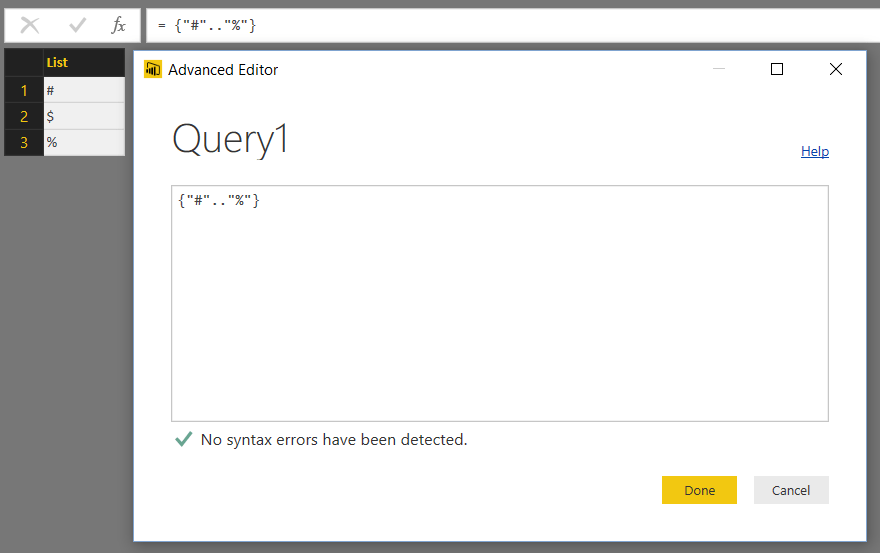
The first character in the expression has to have the lowest Unicode value and the second character has to have the highest Unicode value, and the sequence of characters returned is the list of all characters with Unicode values in that range. As a result, the expression

{"#".."%"}

Returns the list

{"#", "$", "%"}

image

And the expression

{"a".."Z"}

Returns an empty list because the Unicode value of “a” is greater than the Unicode value of “Z”.

This technique doesn’t work for decimal numbers, dates or other data types. If you want a sequence of values of these types you need to use functions list List.Dates() and List.Numbers().

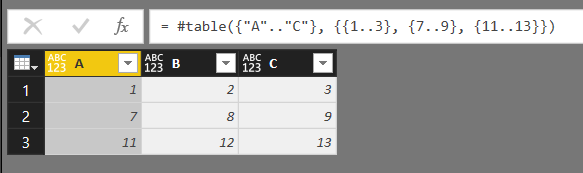
Lists are, of course, used all over the place in M. Building on my recent post on using #table() to create tables with no data source, here’s one last example of using lists containing sequences to create a simple table with three columns and three rows:

#table({"A".."C"}, {{1..3}, {7..9}, {11..13}})

image

Power BI Diagnostics, Trace Logs And Query Execution Times (Again)

I’ve blogged a few times now about how to monitor Power BI query execution times, most recently here, and while using functions like DateTime.FixedLocalNow() is all very well I’ve never been happy with the fact that you have to alter your queries in order to be able to time them. Using the Power BI trace logs always seemed a much better option – and since the log files are in a reasonably easy to understand text format, you can use a Power BI query to load data from them. I wrote a post on importing data from the trace logs (using Power Query) here back in 2014 and Rui Romano has a great post on doing the same thing for Power BI here. The big problem with the Power BI trace logs, though, is that there is too much information in them: they’re really meant for Microsoft internal use, I guess, and not for the likes of you or me. In fact it’s all low-level data in there and there’s no way to see (as far as I know) the overall time taken for a query to run.

However, last month when I was looking for new M functions using the old #shared trick I came across the Diagnostics.Trace() function which allows you to write to the Power BI trace log direct from your query.  After a bit of experimentation, I found out that this function is the key to a truly elegant way of logging query execution times. Here’s a proof-of-concept that I’ve put together to show how it could be used…

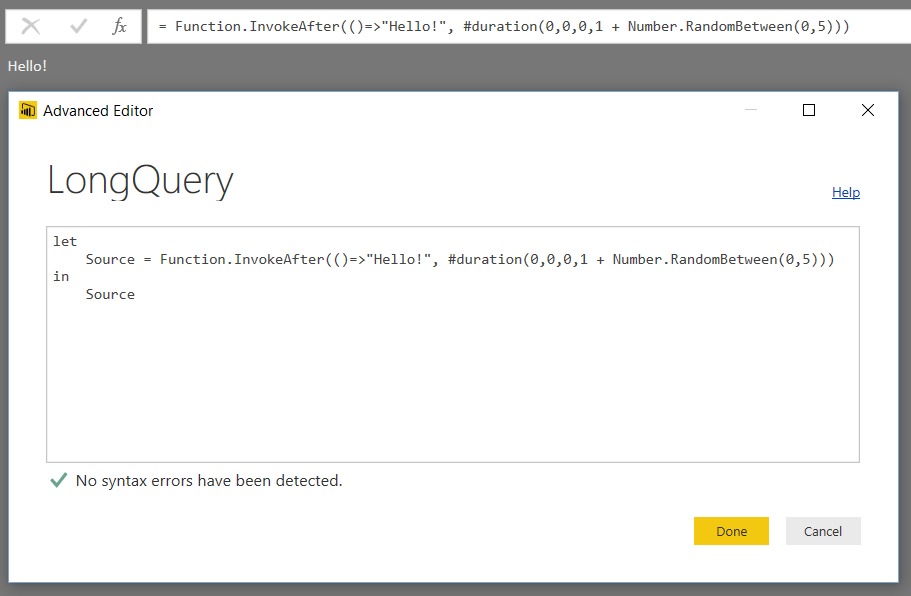
First of all, consider the following query called LongQuery:

[sourcecode language=”text” padlinenumbers=”true”]
let
Source = Function.InvokeAfter(
()=>"Hello!",
#duration(0,0,0,1 + Number.RandomBetween(0,5)))
in
Source
[/sourcecode]

image

It returns the text “Hello” and uses the Function.InvokeAfter() and Number.RandomBetween() functions to wait anything from one to six seconds before doing so. Let’s pretend that this is a real query that does something complex and that we’re trying to tune it.

Rather than alter this query, instead the best thing to do is to create a new query that calls this query through Diagnostics.Trace(). Here’s the code:

[sourcecode language=”text”]
let
Executing = Diagnostics.Trace(
TraceLevel.Information,
#"Trace Message",
()=>LongQuery,
true)
in
Executing
[/sourcecode]

image

I’ve called this query Diagnostics. All it does is return the same value as LongQuery but in doing so it also writes a single message to the trace log. #”Trace Message” is a text parameter that allows you to specify what message to write – you might want to put some kind of version number in here, or a description of any changes you’ve made to your query while tuning it:

image

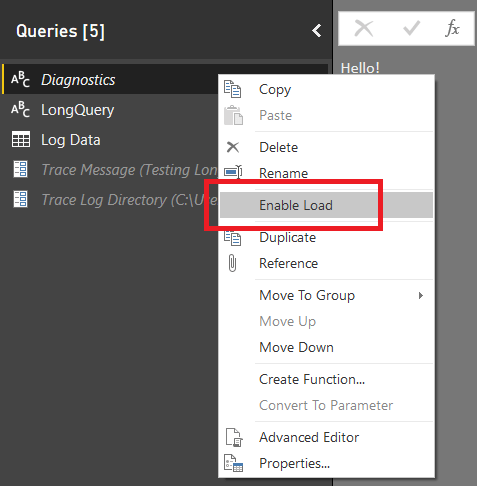
You should also make sure that the Diagnostics query doesn’t get loaded into the data model by making sure the Enable Load option is deselected:

image

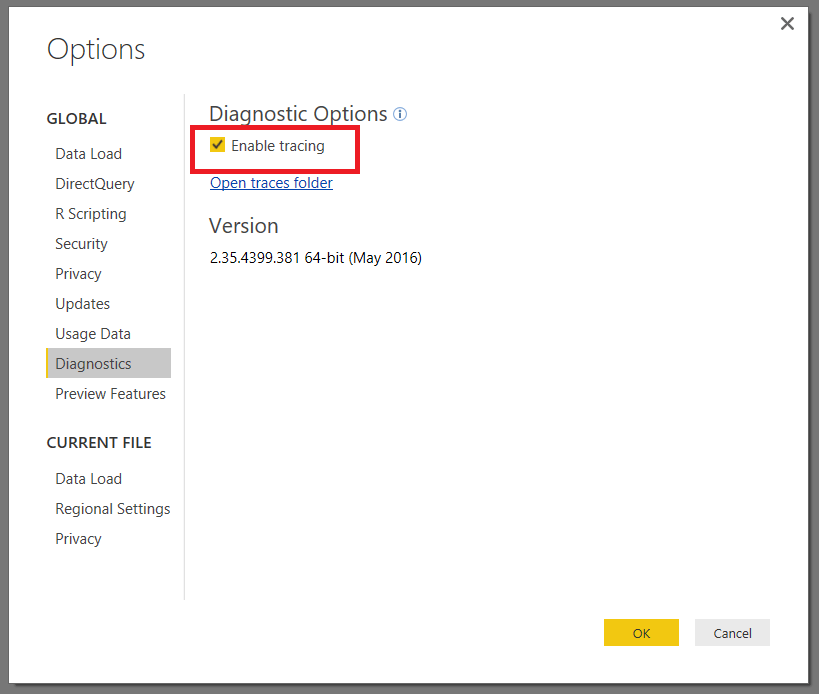
One important thing to remember is that for the Diagnostics query to actually log anything, you need to have the Enable Tracing option turned on in the main Options dialog (you can find this on the File menu in the main Power BI window under Options and settings/Options):

image

image

You will also need to remember to turn this on every time you open Power BI Desktop.

With that done, you just need to hit the Refresh Preview button to refresh the Diagnostics query in the Query Editor window:

image

The Diagnostics query will run, calling the LongQuery query and making an entry in the Power BI trace log. You can find the directory with the trace logs in them by clicking on the Open Traces Folder link in the Options dialog shown above, and you can open the any of the trace log files using your favourite text editor.

image

Loading this trace file into Power BI is pretty straightforward using code similar to that in Rui’s or my blog post. The difference is now, instead of loading everything, you can filter the rows to only load the events created by Diagnostics.Trace(). as far as I can see you can identify these rows because they have the value

“Action”:”Engine/User”,”Message”

Somewhere inside them, as you can see from the last screenshot. Most importantly of all, the duration logged for this event is the amount of time taken to execute the query.

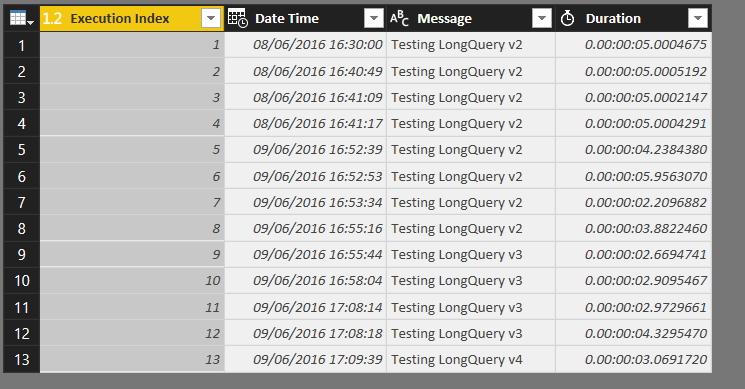
Therefore, with some Power BI M magic, you can load all the data from all of the log files in the log directory, filter the rows to only those created by Diagnostics.Trace(), and end up with a query that gives you something like this:

image

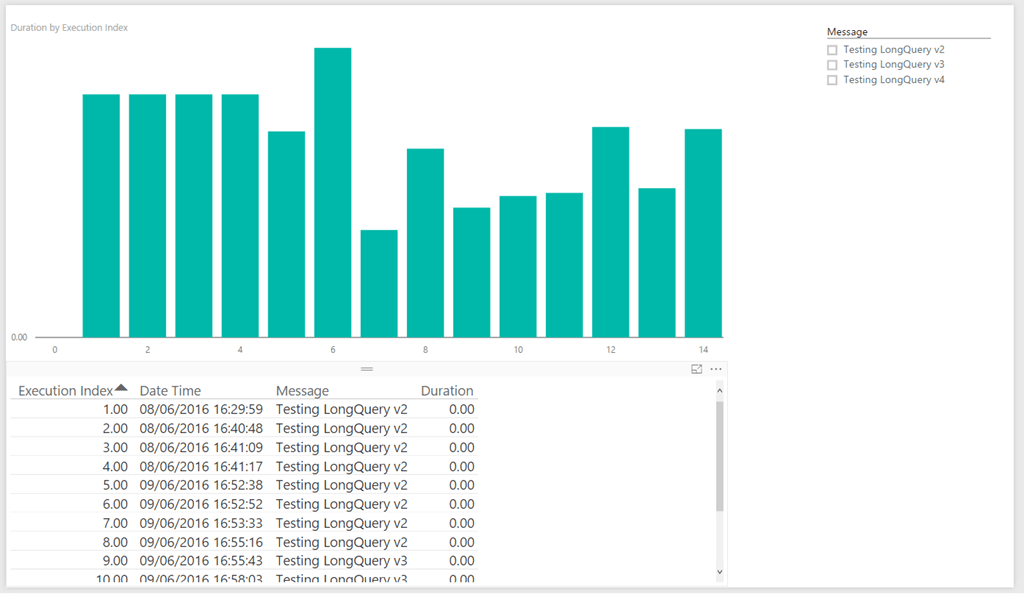
The Execution Index and Date Time columns tell you when the query was executed, the Message column contains the value of the Trace Message parameter at the time the query was executed, and the Duration column tells you how long the query took to execute. You can then, of course, load this table into the data model and build a report that helps you analyse these execution times:

image

To sum up, the workflow for tuning your query is:

  • Make some changes to the LongQuery query that hopefully make it faster
  • Update the Trace Message parameter with some notes about which version of the LongQuery query it is that you’ll be testing
  • Click the Refresh Preview button for the Diagnostics query to test how long LongQuery now runs for
  • Refresh, or load, the query that reads the data from the trace logs so you can see how all of your changes have affected query execution times

Some other closing comments:

  • As I said before, this is just a proof-of-concept and I although haven’t tested it thoroughly but it seems to work.
  • Microsoft may well change the format of its trace logs or make other changes in the future that could break this code shown here.
  • Although I haven’t tried it, this approach should work for Power Query too with some minor modifications.
  • Since it relies on you turning on tracing in Power BI Desktop, this won’t work after you have published your reports. In fact I’ve deliberately structured the queries here so that logging only takes place when you click the Refresh Preview button for the Diagnostics query in the Query Editor window – I found this was the best way to reduce noise in the log files, especially given the fact that a query can be executed multiple times when data is actually being loaded into the data model.
  • That said, the Power BI Enterprise Gateway has its own log files, so maybe you could adapt this approach somehow to work with them?
  • I suspect there are lots of other uses that Diagnostics.Trace() could be put to for even lower-level debugging and analysis of queries, but that’s something for a future blog post.

You can download the sample code as a Power BI template from here. When you open the template you’ll be prompted to enter two parameter values: the message to record for your events in the trace log and the path of your trace log directory.

Creating Tables In Power BI/Power Query M Code Using #table()

After my post earlier this week on creating current day/week/month/year reports in Power BI a few people asked me for a more detailed explanation of the way I was creating tables without using a data source in my M code. This is something I find myself doing quite a lot when I’m loading data with Power BI and Power Query, and while there are several ways of doing this I find that using the #table() intrinsic function is the most elegant option.

Let’s look at some examples. The following query returns a table with two columns (called “First Column” and “Second Column”) and two rows containing the values from 1 to 4:

#table({"First Column", "Second Column"}, {{1,2},{3,4}})
image

No data source is needed – this is a way of defining a table value in pure M code. The first parameter of the function takes a list of column names as text values; the second parameter is a list of lists, where each list in the list contains the values on each row in the table.

In the last example the columns in the table were of the data type Any (the ABC123 icon in each column header tells you this), which means that they can contain values of any data type including numbers, text, dates or even other tables. Here’s an example of this:

#table(
{"First Column", "Second Column"},
{
{1,"Hello"},
{#date(2016,1,1),3}
}
)
image

While this is flexible it’s not exactly practical: in almost all cases the Any data type is a bad choice for loading data, and you need to explicitly set the data type for each column. You can set data types for columns quite easily as a separate step, but it is also possible to set column data types using #table():

#table(
type table
[
#"Number Column"=number,
#"Text Column"=text,
#"Date Column"=date
],
{
{1,"Hello",#date(2016,1,1)},
{2,"World",#date(2017,12,12)}
}
)
image

In this example the first parameter is no longer a list of column names but a declaration of a table type that not only has column names in but also column types. You can see from the icons in the column headers in the screenshot above that the column called “Number Column” has a data type of number, “Text Column” has a data type of text, and “Date Column” has a data type of date.

Of course if you need a fixed table value in Power BI you could use the “Enter Data” button or, if you’re using Excel and Power Query you could create an Excel table and then use the Excel.CurrentWorkbook() function to load the contents of it; if you or your end users need to edit the values in your table easily then you should use one of these two options. On the other hand if you don’t want users to be able to edit the values in the table or, more likely, you are generating the contents of your table using functions that return lists (as in my previous post) then #table() is the way to go.

Creating Current Day, Week, Month And Year Reports In Power BI Using Bidirectional Cross-Filtering And M

One very common requirement when creating a Power BI report is the ability to apply a filter for the current day, week, month, quarter or year. There are several ways of implementing this: you could add relative date columns to your Date table as I show here (I used DAX calculated columns but you could also do this in M quite easily too); you could also build the filter into the DAX for your measures, although that could mean you end up with a lot of quite complex measures.

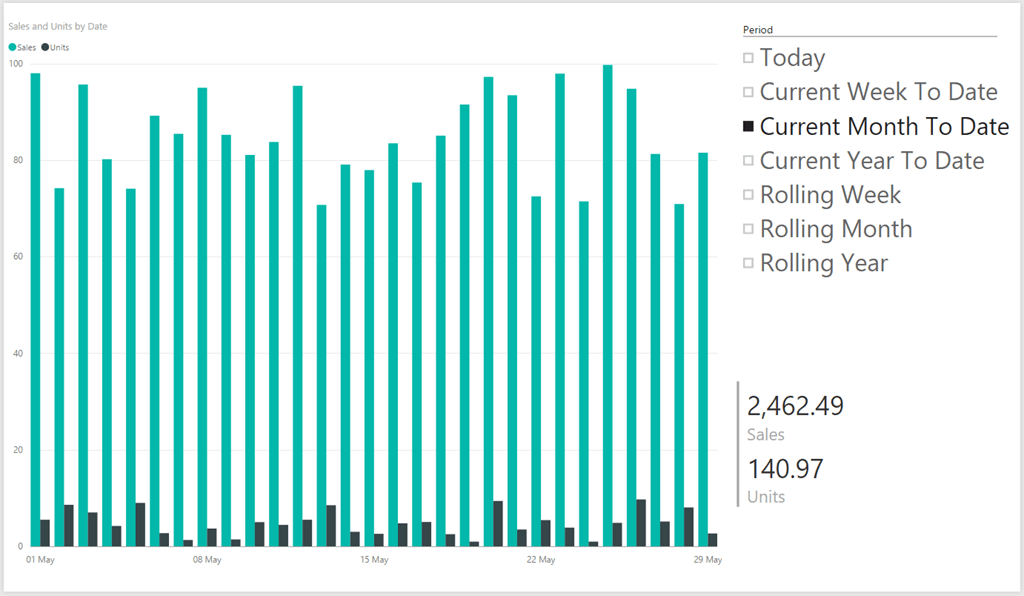
Last week I received an email asking for help with an interesting variation on this problem: how can you create a report with a single slicer that allows you to switch between showing data for the current day, week, month or year? The requirement to have a single slicer is important here: if you create new columns on the date table, that would allow you to have a single slicer that allows for selecting the current day or any relative day, or the current week or any relative week, or the current month and any relative month, or the current year and any relative year,  but it wouldn’t allow you to select weeks, months and years together in the same slicer.

Here are some screenshots showing what we want to achieve: a report with two measures and a single slicer that allows the user to switch between displaying data for a variety of relative time periods:

image

image

image

The way to achieve this is not all that different from the calculated column approach, but it requires a separate table to model the many-to-many relationship between all the required relative period selections and the dates in them, as well as the use of bidirectional cross-filtering between tables (which I blogged about here). The data model I used for this report looks like this:

image

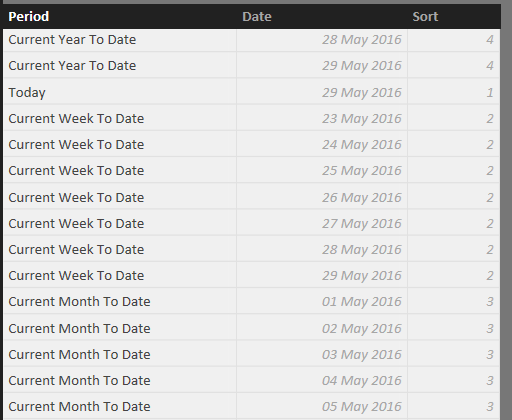
The Sales table just contains sales data; the Date table is a normal Power BI date table. The Period table is the interesting table here: it contains one row for each combination of relative time period (eg “Today”, “Current Week To Date”, “Rolling Month”) and date:

image

It’s the Period column on this table that is used to create the slicer in the screenshots above. The Sort column is used along with Power BI’s Sort By Column functionality to make the values in the Period column appear in a sensible order in the report.

Notice also that on the relationship between the Period table and the Date table the Cross filter direction property is set to Both:

image

This means that a selection on the Period table travels up the relationship to the Date table and then back down the relationship from Date to Sales. For example, selecting “Current Week” in the Period table will select the dates in the current week on the Date table, which in turn selects the rows for those dates on the Sales table.

The challenge, though, is to write the query to populate the Period dimension. I’ve done this in two parts. First, here’s a function called CreatePeriodTable that returns a table for a single time period selection. It takes the name of the time period and a start date and end date, and will return a table with one row for each date in the date range:

[sourcecode language=”text” padlinenumbers=”true”]
(
PeriodName as text,
StartDate as date,
EndDate as date,
SortOrder as number
) as table =>
let
DayCount = Duration.Days(EndDate-StartDate)+1,
DateList = List.Dates(StartDate,DayCount,#duration(1,0,0,0)),
AddPeriodName = List.Transform(DateList,
each {PeriodName,_,SortOrder}),
CreateTable = #table(
type table[Period=text, Date=date, Sort=number],
AddPeriodName)
in
CreateTable
[/sourcecode]

For example, calling this function like so:

[sourcecode language=”text”]
CreatePeriodTable("Demo", #date(2016,1,1), #date(2016,1,5),1)
[/sourcecode]

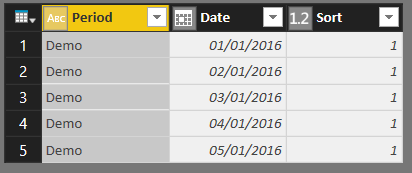
Returns the following table (with the dates shown in dd/mm/yyyy format):

image

Second, here’s a query that calls this function once for each of the time periods you want to be able to select by and creates a single table that contains all of the rows returned by each of the function calls:

[sourcecode language=”text”]
let
TodaysDate = Date.From(DateTimeZone.FixedUtcNow()),
Ranges = {
{"Today",
TodaysDate,
TodaysDate,
1},
{"Current Week To Date",
Date.From(Date.StartOfWeek(TodaysDate)),
TodaysDate,
2},
{"Current Month To Date",
Date.From(Date.StartOfMonth(TodaysDate)),
TodaysDate,
3},
{"Current Year To Date",
Date.From(Date.StartOfYear(TodaysDate)),
TodaysDate,
4},
{"Rolling Week",
Date.AddWeeks(TodaysDate,-1) + #duration(1,0,0,0),
TodaysDate,
5},
{"Rolling Month",
Date.AddMonths(TodaysDate,-1) + #duration(1,0,0,0),
TodaysDate,
6},
{"Rolling Year",
Date.AddYears(TodaysDate,-1) + #duration(1,0,0,0),
TodaysDate,
7}
},
GetTables = List.Transform(Ranges,
each CreatePeriodTable(_{0}, _{1}, _{2}, _{3})),
Output = Table.Combine(GetTables)

in
Output
[/sourcecode]

In this query the Ranges step contains a list of lists, where each list in the list represents a time period with its start and end dates in the same order that you’d pass these values as parameters to the CreatePeriodTable() function. I’ve deliberately structured the code to make it easy to add new time period to the list. Hopefully the example time periods in the query above give you a good idea of what’s possible in M and all the functions it gives you for calculating different dates. The GetTables step loops over this list and calls the CreatePeriodTable() function for each list in the list, and the Output step combines all the data into a single table.

All of the dates ranges here end with today’s date, as returned by the DateTimeZone.FixedUtcNow() function, but you may want to check out Ken’s post here on handling time zones in M depending on your exact requirements. Because this happens in M when the data is loaded the value of today’s date will be fixed at the point in time that data refresh took place.

You can download the example workbook for this post here.

Understanding Let Expressions In M For Power BI And Power Query

When you start writing M code for loading data in Power Query or Power BI, one of the first things you’ll do is open up the Advanced Editor for a query you’ve already built using the UI. When you do that you’ll see a very scary chunk of code (and at the time of writing there’s no intellisense or colour coding in the Advanced Editor, making it even more scary) and you’ll wonder how to make sense of it. The first step to doing so is to understand how let expressions work in M.

Each query that you create in Power BI Desktop or Power Query is a single expression that, when evaluated, returns a single value – and that single value is usually, but not always, a table that then gets loaded into the data model. To illustrate this, open up Power BI Desktop (the workflow is almost the same in Power Query), click the Edit Queries button to open the Query Editor window and then click New Source/Blank Query to create a new query.

image

Next, go to the View tab and click on the Advanced Editor button to open the Advanced Editor dialog:

image

You’ll notice that this doesn’t actually create a blank query at all, because there is some code visible in the Advanced Editor when you open it. Delete everything there and replace it with the following M expression:

[sourcecode language=”text” padlinenumbers=”true”]
"Hello " & "World"
[/sourcecode]

image

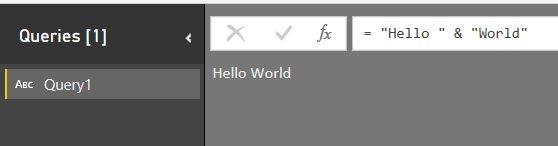
Hit the Done button and the expression will be evaluated, and you’ll see that the query returns the text value “Hello World”:

image

Notice how the ABC icon next to the name of the Query – Query1 – indicates that the query returns a text value. Congratulations, you have written the infamous “Hello World” program in M!

You might now be wondering how the scary chunk of code you see in the Advanced Editor window for your real-world query could possibly be a single expression – but in fact it is. This is where let expressions come in: they allow you to break a single expression down into multiple parts. Open up the Advanced Editor again and enter the following expression:

[sourcecode language=”text”]
let
step1 = 3,
step2 = 7,
step3 = step1 * step2
in
step3
[/sourcecode]

image

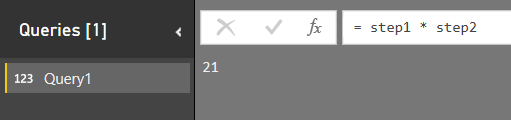
Without knowing anything about M it’s not hard to guess that this bit of code returns the numeric value 21 (notice again that the 123 icon next to the name of the query indicates the data type of the value the query returns):

image

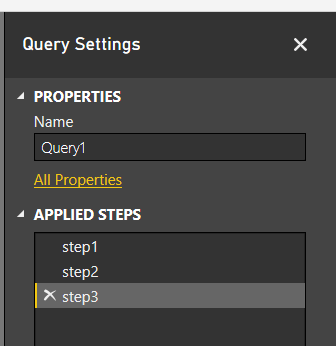
In the M language a let expression consists of two sections. After the let comes a list of variables, each of which has a name and an expression associated with it. In the previous example there are three variables: step1, step2 and step3. Variables can refer to other variables; here, step3 refers to both step1 and step2. Variables can be used to store values of any type: numbers, text, dates, or even more complex types like records, lists or tables; here, all three variables return numbers. The Query Editor is usually clever enough to display these variables as steps in your query and so displays then in the Applied Steps pane on the right-hand side of the screen:

image

The value that the let expression returns is given in the in clause. In this example the in clause returns the value of the variable step3, which is 21.

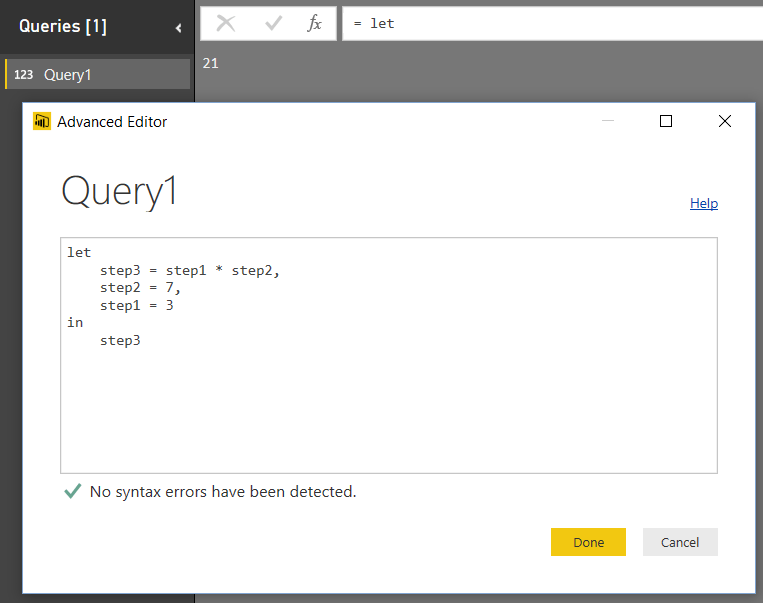
It’s important to understand that the in clause can reference any or none of the variables in the variable list. It’s also important to understand that, while the variable list might look like procedural code it isn’t, it’s just a list of variables that can be in any order. The UI will always generate code where each variable/step builds on the value returned by the previous variable/step but when you’re writing your own code the variables can be in whatever order that suits you. For example, the following query also returns the value 21:

[sourcecode language=”text”]
let
step3 = step1 * step2,
step2 = 7,
step1 = 3
in
step3
[/sourcecode]

image

The in clause returns the value of the variable step3, which in order to be evaluated needs the variables step2 and step1 to be evaluated; the order of the variables in the list is irrelevant (although it does mean the Applied Steps no longer displays each variable name). What is important is the chain of dependencies that can be followed back from the in clause.

To give another example, the following query returns the numeric value 7:

[sourcecode language=”text”]
let
step3 = step1 * step2,
step2 = 7,
step1 = 3
in
step2
[/sourcecode]

image

In this case, step2 is the only variable that needs to be evaluated for the entire let expression to return its value. Similarly, the query

[sourcecode language=”text”]
let
step3 = step1 * step2,
step2 = 7,
step1 = 3
in
"Hello" & " World"
[/sourcecode]

image

…returns the text value “Hello World” and doesn’t need to evaluate any of the variables step1, step2 or step3 to do this.

The last thing to point out is that if the names of the variables contain spaces, then those names need to be enclosed in double quotes and have a hash # symbol in front. For example here’s a query that returns the value 21 where all the variables have names that contain spaces:

[sourcecode language=”text”]
let
#"this is step 1" = 3,
#"this is step 2" = 7,
#"this is step 3" = #"this is step 1" * #"this is step 2"
in
#"this is step 3"
[/sourcecode]

image

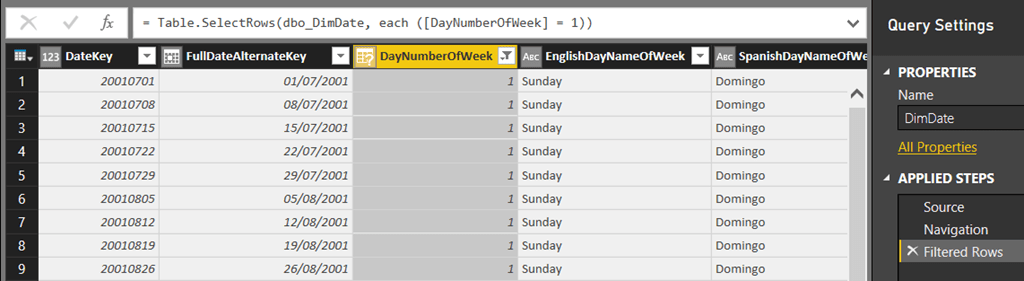
How does all this translate to queries generated by the UI? Here’s the M code for a query generated by the UI that connects to SQL Server and gets filtered data from the DimDate table in the Adventure Works DW database:

[sourcecode language=”text”]
let
Source = Sql.Database("localhost", "adventure works dw"),
dbo_DimDate = Source{[Schema="dbo",Item="DimDate"]}[Data],
#"Filtered Rows" = Table.SelectRows(dbo_DimDate,
each ([DayNumberOfWeek] = 1))
in
#"Filtered Rows"
[/sourcecode]

Regardless of what the query actually does, you can now see that there are three variables declared here, #”Filtered Rows”, dbo_DimDate and Source, and the query returns the value of the #”Filtered Rows” variable. You can also see that in order to evaluate the #”Filtered Rows” variable the dbo_DimDate variable must be evaluated, and in order to evaluate the dbo_DimDate variable the Source variable must be evaluated. The Source variable connects to the Adventure Works DW database in SQL Server; dbo_DimDate gets the data from the DimDate table in that database, and #”Filtered Rows” takes the table returned by dbo_DimDate and filters it so that you only get the rows here the DayNumberOfWeek column contains the value 1.

image

That’s really all there is to know about let expressions. It explains why you can do the kind of conditional branching that Avi Singh describes here; and also why, when I first tried to come up with a way to time how long a query takes to execute, I had to bend over backwards to ensure that all the variables in my let expression were executed in the correct order (though it turns out there’s an easier way of doing this). I hope you find this useful when writing your own M code.

Creating M Functions From Parameterised Queries In Power BI

Query parameters are, in my opinion, one of the most important features added to Power BI recently. The official blog post describing how to use them is great (read it if you haven’t done so already) but it misses out one other cool new feature that I only discovered by accident the other day: it’s now super-easy to create M functions from parameterised queries.

Why is this important? In Power BI (and indeed in Power Query), M functions are the key to combining data from multiple data sources that have the same structure. For example, if you have a folder of Excel workbooks and you want to read the data from Sheet1 in each of them to create a single table for loading into Power BI, functions are the key. Here are some blog posts with examples:

Matt Masson on iterating over multiple web pages:
http://www.mattmasson.com/2014/11/iterating-over-multiple-pages-of-web-data-using-power-query/

Ken Puls on combining data from multiple Excel workbooks:
http://www.excelguru.ca/blog/2015/02/25/combine-multiple-excel-workbooks-in-power-query/

My M function showing a generic function for combining any data from Excel:
https://blog.crossjoin.co.uk/2014/11/20/combining-data-from-multiple-excel-workbooks-with-power-querythe-easy-way/

All of these examples involve writing M code manually. The big change in the latest version of Power BI Desktop is that you can do the same thing using just the UI.

Let’s take the classic example of combining data from multiple Excel workbooks and update it to show how things work now.

Say you have a folder containing three Excel workbooks containing sales data for January, February and March and you want to load data from all three into a single table into Power BI. The first thing to do is to create a new parameter in Power BI Desktop that returns the filename, including path, of one of the Excel files. Call it ExcelFilePath and configure it as shown here:

image

Next, you need to create a query that connects to the Excel file whose filename is used in the parameter and load the data you want from it. In this case let’s say you want to load the data from Sheet1:

image

This is all very straightforward; here’s the query that you’ll get:

image

Unfortunately, at the time of writing, the Excel source doesn’t support using parameters when creating a new query, so you have to create a query and then edit it to use the filename that the parameter returns. You can do this by clicking on the gear icon next to the Source step in the query:

image

In the dialog that appears, click the icon next to the File Path property and choose Parameter, then from the dropdown menu choose the name of the parameter you created earlier:

image

Now here comes to the good bit. In the Queries pane on the left-hand side of the screen, right-click on the name of the query you just created and select Create Function:

image

This option allows you to take any parameterised query and create a function from it. When you do this, you’ll see a dialog asking for the name of the new function to be created (I’ve called my function GetSheet1) and allowing you to change the name of the parameters:

image

Here’s the original M code for the query with the parameterised Source step highlighted:

[sourcecode language=”text” padlinenumbers=”true” highlight=”2″]
let
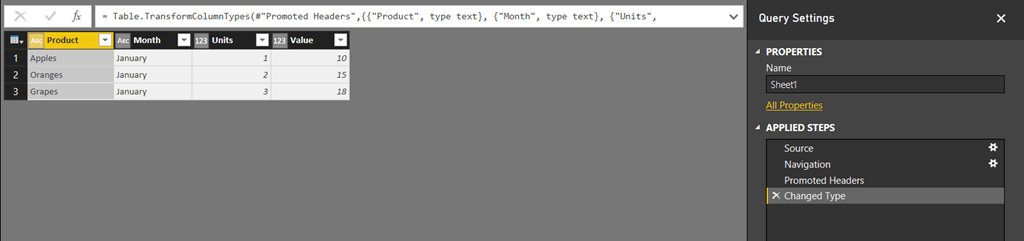
Source = Excel.Workbook(File.Contents(ExcelFilePath), null, true),
Sheet1_Sheet = Source{[Item="Sheet1",Kind="Sheet"]}[Data],
#"Promoted Headers" = Table.PromoteHeaders(Sheet1_Sheet),
#"Changed Type" = Table.TransformColumnTypes(#"Promoted Headers",
{{"Product", type text}, {"Month", type text},
{"Units", Int64.Type}, {"Value", Int64.Type}})
in
#"Changed Type"
[/sourcecode]

Here’s the M code for the new query created after Create Function has been selected:

[sourcecode language=”text” highlight=”2,3″]
let
Source = (ExcelFilePath as text) => let
Source = Excel.Workbook(File.Contents(ExcelFilePath), null, true),
Sheet1_Sheet = Source{[Item="Sheet1",Kind="Sheet"]}[Data],
#"Promoted Headers" = Table.PromoteHeaders(Sheet1_Sheet),
#"Changed Type" = Table.TransformColumnTypes(#"Promoted Headers",
{{"Product", type text}, {"Month", type text},
{"Units", Int64.Type}, {"Value", Int64.Type}})
in
#"Changed Type"
in
Source
[/sourcecode]

Where the original query points to the workbook whose path is returned by the ExcelFilePath query parameter, the new function takes a parameter (also called ExcelFilePath) to which any other query can pass any text value.

Now you have your function, the final step is to call the function on a table containing the names of all of the Excel files in your folder. Create a new query using the From Folder source:

image

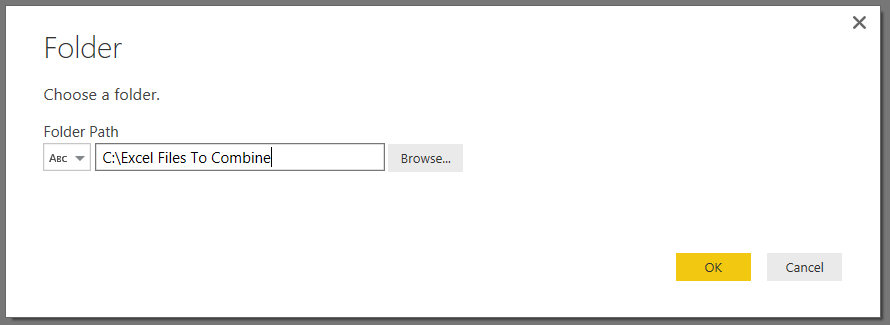
…then point Power Query to the folder containing the names of all of the Excel files:

image

Remove all the columns in the table except Folder Path and Name, drag the Folder Path column before the Name column, then select both remaining columns, right-click and select Merge Columns to create a single column (called FullPath here) containing the full path of all the Excel files:

image

image

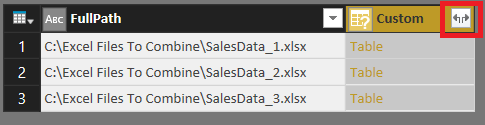
Next you need to click the Custom Column button and call the GetSheet1 function for the text in the FullPath column for each row in the table. Here’s the expression to use:

[sourcecode language=”text”]
GetSheet1([FullPath])
[/sourcecode]

image

Last of all, click on the Expand icon in the right-hand corner of the new column:

image

…and you have a table that contains all of the data from Sheet1 on all of the files in the folder:

image

Now for the bad news: queries that use functions like this can’t be refreshed after they have been published to PowerBI.com (see also this thread for more details). This could be why the functionality wasn’t publicised in the post on the Power BI blog. Hopefully this will change soon though…?

So, to sum up, it’s the early stages of an important and powerful new piece of functionality. In the past, a lot of the times when I found myself writing M code it was to create parameterised queries and functions; in the future I’m going to be writing a lot less M code, which is great news. I can’t wait to see how this develops over the next few months and I hope it turns up in Power Query too.

The M Code Behind Power BI Parameters

For me the most exciting new feature in Power BI in a long while is the appearance of Query Parameters for data loading. We have been promised an official blog post explaining how they work (although they are very easy to use) and in fact Soheil Bakhshi has already two very good, detailed posts on them here and here. What I want to do in this post, however, is look at the M code that is generated for them and see how it works.

Consider the following parameter built in Power BI Desktop that has, as its possible values, the names of all of the days of the week:

image

The first thing to notice is that parameters are shown as a special type of query in the Queries Pane, but they are still a query:

image

This means that you can open up the Advanced Editor and look at the M code for the query. Here’s the code for the query shown above:

[sourcecode language=”text” padlinenumbers=”true”]
"Monday"
meta
[
IsParameterQuery=true,
List={"Monday", "Tuesday", "Wednesday",
"Thursday", "Friday", "Saturday", "Sunday"},
DefaultValue="Monday",
Type="Text",
IsParameterQueryRequired=true
]
[/sourcecode]

From this you can see that the value returned by the parameter query is just a single piece of text – it’s the value “Monday” that is set as the Current Value, that’s to say the value returned by the parameter itself. The interesting stuff is all in the metadata record associated with the value. I blogged about metadata here, so you may want to read that post before going any further; it’s pretty clear that the fields in the metadata record correspond to the values set in the UI. All of the fields in the metadata record can be edited in the Advanced Editor if you want.

When the parameter is used in another query it is referenced like any other query value. For example, if you load the DimDate table from the Adventure Works DW sample database and use the parameter above to filter the EnglishDayNameOfWeek column then the code generated in the UI looks like this:

[sourcecode language=”text” highlight=”10″]
let
Source =
Sql.Databases("localhost"),
#"Adventure Works DW" =
Source{[Name="Adventure Works DW"]}[Data],
dbo_DimDate =
#"Adventure Works DW"{[Schema="dbo",Item="DimDate"]}[Data],
#"Filtered Rows" =
Table.SelectRows(dbo_DimDate,
each [EnglishDayNameOfWeek] = Day)
in
#"Filtered Rows"
[/sourcecode]

The filtering takes place in the #”Filtered Rows” step and you can see where the name of the parameter – Day – is used in the Table.SelectRows() function to filter the EnglishDayNameOfWeek column. This is nothing new in terms of the language itself because you have always been able to return values of any data type from a query, not just tables, and you have always been able to reference queries in other queries like this – in fact you can see me write the same kind of code manually in this video. What is new is that there is now a UI to do this and there’s no need to write any code.

Personally, I think the Power BI team have done a great job here in terms of usability and clearly a lot of thought has gone into this feature. It doesn’t do everything I would want yet though: the ability to bind the list of available values to the output of another query and the ability to select multiple parameter values at the same time are obvious missing features (and ones that would be needed to match the parameter functionality in SSRS). However I would not be surprised to see them appear in a future version of Power BI.

After seeing the code, I wondered whether I could edit the code in the parameter query to make it do more interesting things. For example, even if the UI doesn’t support data-driven lists of available values for a parameter, it looks as though it should be possible to replace the hard-coded list with a list of values returned by another query. Unfortunately this does not work: any changes I tried to the parameter query code were either ignored or removed completely. A bit of a disappointment but again, hopefully this will be possible in a future version.

Timing M Query Execution In Power Query And Power BI (Revisited)

Some time ago I wrote the following post on how to work out how long your M query takes to execute in Power Query:

http://blog.crossjoin.co.uk/2014/11/17/timing-power-query-queries/

While it’s still relevant for Power Query and now of course Power BI (and it also illustrates some interesting facts about query execution), recently I had an interesting discussion with Colin Banfield in the comments section of that post that led to us finding an easier way of measuring query execution times.

In M, the DateTime.LocalNow() function returns the current system date and time at the time the function is called – which means that you could call it multiple times in the same query and get different results. There’s also the DateTime.FixedLocalNow() function which also returns the system date and time; the difference between the two is, as the documentation says:

This value is fixed and will not change with successive calls, unlike DateTime.LocalNow, which may return different values over the course of execution of an expression.

The question here is, though, what time does DateTimeFixedLocalNow() actually return? I asked on the Power Query forum here and Ehren from the Power Query dev team revealed that it returns the system date and time at the point when the query begins.

This means that it can be used to simply the original method I used to find query execution. Here’s a query that uses Function.InvokeAfter() to create a delay of 5 seconds during query execution and returns the difference between the values returned by DateTime.LocalNow() and DateTime.FixedLocalNow():

[sourcecode language=”text” padlinenumbers=”true”]
let
SomeFunction = ()=> DateTime.LocalNow(),
InvokeAfter5Secs =
Function.InvokeAfter(SomeFunction, #duration(0,0,0,5)),
Output =
Duration.ToText(InvokeAfter5Secs – DateTime.FixedLocalNow())
in
Output
[/sourcecode]

image

If you’re using this on a real query I strongly recommend you read my original post carefully and make sure that all of the steps in your query are executed, but does make things a little bit easier.

Dynamic Column Selection In Custom Columns In Power BI/Power Query/M

When you’re writing an M expression for a custom column in Power BI or Power Query it’s easy to reference the values in other columns. A slightly more difficult question, however, is how can you reference column values dynamically? For example, given the following input table:

image

How can you use the values in the “Column To Select” column to dynamically select values from either Column 1, Column 2 or Column 3? For example, on the first line of the table the “Column To Select” column contains the value 2, so the calculated column should contain the value from “Column 2”; on the second line of the table the “Column To Select” column contains the value 1, so the calculated column should contain the value from “Column 1” and so on:

image

There are a number of different ways to achieve this. You could, for instance, write a nested if or do some other kind of fancy conditional logic in M, but this could result in a lot of code. You could also unpivot all the columns except “Column To Select”, do some filtering, then pivot the data again but that would also be quite complicated. Probably the easiest way of doing this is with the Record.Field() function, which allows you to get the value of any given field in a record by passing the name of that field as a text value.

Here’s an example query that generates the table shown in the first screenshot above in its first step, sets some data types on the columns in the second step, then creates the custom column shown in the second screenshot in the final step:

[sourcecode language=”text” padlinenumbers=”true” highlight=”18,19,20″]
let
Source = #table(
{"Column 1", "Column 2",
"Column 3", "Column To Select"},
{{10,20,30,2},
{30,40,50,1},
{50,60,70,3}}),
#"Changed Type" = Table.TransformColumnTypes(
Source,
{{"Column 1", Int64.Type},
{"Column 2", Int64.Type},
{"Column 3", Int64.Type},
{"Column To Select", Int64.Type}}),
#"Added Custom" = Table.AddColumn(
#"Changed Type",
"Selected Column Value",
each
Record.Field(
_,
"Column " & Text.From([Column To Select])))
in
#"Added Custom"
[/sourcecode]

Here’s the expression for the custom column isolated, in the form that you would use in the Add Custom Column dialog:

[sourcecode language=”text”]
Record.Field(_, "Column " & Text.From([Column To Select]))
[/sourcecode]

image

Understanding how to use the Record.Field() function here leads us to an interesting side discussion about custom columns, functions, records and each expressions. The full M expression for the third step in the query is:

[sourcecode language=”text”]
Table.AddColumn(
//the table returned by the previous step
#"Changed Type",
//the name of the new custom column
"Selected Column Value",
//a function to call for each row of the table
//returning the value to display in the custom column
each Record.Field(_, "Column " & Text.From([Column To Select])))
[/sourcecode]

The first two parameters of the Table.AddColumn() function are straightforward but if you read the documentation you’ll see that the third parameter requires a value of type function. This function is called for every row in the table and returns the values in the custom column. It doesn’t look like it but there is a new function being defined here. In M an each expression can be used to define a function that has no name and that takes one parameter whose name is _ (ie the underscore character). The Table.AddColumn() function passes this new function a value of type record representing all of the values in the current row of the table, and that means Record.Field() can access this record by using _. What’s more, when referring to fields in this record you don’t even have to say _[Column To Select], you can drop the underscore and just say [Column To Select], as in the code example above. All this means that the expression

[sourcecode language=”text”]
each Record.Field(_, "Column " & Text.From([Column To Select]))
[/sourcecode]

is basically the same as

[sourcecode language=”text”]
(_)=> Record.Field(_, "Column " & Text.From(_[Column To Select]))
[/sourcecode]

…which, if you know a bit of M, makes a lot more sense but for the average user is probably more intimidating.