SQLDay 2013 Conference in Poland

This is just a quick note to say that I’ll be speaking, and running a preconference seminar, at the SQLDay 2013 conference in Poland on the 22nd-24th May. I’m looking forward to it because I’ve never been to Poland before!

You can find all the details of my precon, “Real World Cube Design and Performance Tuning with Analysis Services”, here:
http://conference.plssug.org.pl/lang/en-us/agenda/sql-day-2013/sroda-22-05wednesday-22-05/w1-bi-track-real-world-cube-design-and-performance-tuning-with-analysis-services/

If you can’t make it to Poland, I’d love to see you at the PASS BA Conference (btw the discount code BAC521BL now gives you a $200 discount if you haven’t booked already), DatabaseDays Switzerland, SQLBits or one of my courses in London. Blimey, that’s a lot of teaching… and there’s more to be announced soon too.

Data Explorer (Power Query) –Where Does The Real Work Get Done?

NOTE: This post was written before Data Explorer was renamed as Power Query. All of the content is still relevant to Power Query.

Yes, I know, I’ve been blogging a lot over the last week or so – I can’t help it, there’s been so much interesting stuff to blog about! Anyway, here’s yet another post about Data Explorer; not about functionality this time, but the result of some investigations about how it works and some ideas that resulted from that.

After having played around with Data Explorer so much, I started to wonder just how scalable it is. In the course of doing this I found out that while Data Explorer can (and must) do a lot of the data processing logic itself, it pushes as much of that logic back to the data source whenever it can. For example, if you connect to the Adventure Works DW database in SQL Server and then implement some simple steps in a Data Explorer query that:

  1. Import everything from the DimDate table, hiding everything except the DayNumberOfWeek column
  2. Filter it so that DayNumberOfWeek is greater than 5:
    = Table.SelectRows(DimDate, each [DayNumberOfWeek] > 5)
  3. Return the count of the number of rows that are returned:
    = Table.RowCount(FilteredRows)

…you can see if you run a Profiler trace that all of this logic is translated to SQL and not evaluated in Data Explorer itself. Here’s the final SQL statement generated by the third step above:

select count(1) as [$Item]
from
(
select [_].[DayNumberOfWeek]
from
(
select [DayNumberOfWeek]
from [dbo].[DimDate] as [$Table]
) as [_]
where [_].[DayNumberOfWeek] > 5
) as [$Table]

I’m not sure which other data sources this is possible for, but it’s a good thing to see – you’re more likely to get good performance by doing the work back in the database than on your desktop. I wonder if it does this for Hive queries? If so, that would make it very useful for working with Hadoop/HDInsight.

And what about data sources where this isn’t possible though, like csv? I decided to test it out by loading a very large (1.4 GB) csv file I have with two columns containing integer values and 86 million rows, filtering it so that one of the column values was not null and less than 500000, and finding the resulting count of rows. Unfortunately I had to kill the query refresh after 15 minutes… In contrast, loading the same file into the Excel Data Model took almost exactly 6 minutes, and a DAX measure to do the same count/filter operation returned instantly. Not really a surprise I suppose, but it would be nice to have the option when working with csv files to load data into the Excel Data Model before you did anything else and then, when you did your transforms in Data Explorer, have those translated back to DAX queries and calculations. Alas, Data Explorer doesn’t support the Excel Data Model, PowerPivot or SSAS as data sources at the moment – I hope this changes soon.

This leads me on to the observation that in a lot of self-service BI scenarios the distinction between ETL and reporting can be blurred. If you just want to see a simple table showing your sales broken down by product in an Excel spreadsheet, you could build this quite easily with Data Explorer and not go near PowerPivot or the Excel Data Model. It would probably be easier to build too, since Data Explorer allows you to break complex operations into multiple steps, whereas putting all your logic in a single DAX expression can be mind-bendingly difficult (I’m reminded of this post I wrote two years ago). On the other hand you can do a lot of ETL-type things inside PowerPivot with calculated columns and measures; people have also been asking for the ability to use tables in the Excel Data Model as a data source for other tables (see here for example), for ETL purposes – it can be much faster and more elegant to use DAX to do some types of ETL work than SQL or SSIS. In the future I’d love to see tighter integration between Data Explorer and the Excel Data Model/PowerPivot so that we can get the best of both worlds.

Calling A Web Service From Data Explorer (Power Query), Part 2

NOTE: This post was written before Data Explorer was renamed as Power Query. All of the content is still relevant to Power Query.

Don’t you hate it when you get ready to blog about something cool, and then someone comes along and beats you to it? That’s what’s just happened to me – Matt Masson just wrote an excellent blog post on how to do address lookup against a web service here:
http://www.mattmasson.com/2013/03/dynamic-lookups-with-data-explorer/
That’s what I was going to write about in part 2 of this series. I have to say he did a better job than I would have done though, and shows off several cool tricks I hadn’t seen before…

Ah well, so it goes – and anyway there are a few things I was going to say that are still worth saying. If you remember, in Part 1 I showed how to call the Google Distance Matrix API from Data Explorer, but I hard-coded the start and end points in the expression I used. How can you get the start and end points directly from Excel? Well it turns out that Data Explorer can read values direct from Excel tables.

To start with, you need to create some Excel tables to hold the values you want to use. I created two Excel tables called Origin and Destination to hold the two values I needed:

image

I can then take the value from the first row in the sole column of each table (which are again called Origin and Destination, as you can see) by using

Excel.CurrentWorkbook(){[Name=”Origin”]}[Content]{0}[Origin]

and

Excel.CurrentWorkbook(){[Name=”Destination”]}[Content]{0}[Destination]

Here’s the full source expression with the hard-coded values replaced:

=
Xml.Document(
Web.Contents(
http://maps.googleapis.com/maps/api/distancematrix/xml”
, [Query = [
origins= Excel.CurrentWorkbook(){[Name=”Origin”]}[Content]{0}[Origin]
, destinations = Excel.CurrentWorkbook(){[Name=”Destination”]}[Content]{0}[Destination]
, mode = “driving”, sensor = “false” ] ]))

Now, you can enter any address in the Origin and Destination tables, click Refresh on the Query as shown in the screenshot below:

image

And the query will be rerun with the new parameters. Note that it might also be a good idea to URL encode any text that you enter in these tables, using the EncodeURL() Excel function; I haven’t done so here because I’m using UK postcodes, which don’t need URL encoding, as my origins and destinations to make things simple.

It’s also possible to use the results of one query inside another query. Data Explorer allows you to use an Excel table as the source for a query:

image

And selecting the Destination Excel table as a source gives the following expression:

= Excel.CurrentWorkbook(){[Name=”Destination”]}[Content]

The easy way to use any value from an existing query as the starting point for a new query is to right-click on a cell and select Add As New Query:

image

Doing this creates a new query with the value you clicked on a source:

image

Here’s the expression for the only step in the newly-created query:

= Destination{0}[Destination]

image

Even if this new query isn’t any use on its own, the expression shown here can be used in other queries. Here’s the original web service call adapted to use two other queries as its source:

= Xml.Document(
Web.Contents(
http://maps.googleapis.com/maps/api/distancematrix/xml”
, [Query = [
origins= Origin{0}[Origin]
, destinations = Destination{0}[Destination]
, mode = “driving”, sensor = “false” ] ]))

However, as Matt shows in his post, this only works if Fast Combine is enabled, otherwise you’ll see an error message.

You can download the sample workbook for this post here.

Calling A Web Service From Data Explorer (Power Query), Part 1

NOTE: This post was written before Data Explorer was renamed as Power Query. All of the content is still relevant to Power Query.

Last week I showed how you could use the WebService() function in Excel 2013 to bring location data into Excel 2013. Since this is a topic I have a particular interest in, this week I’ll show you how to do the same thing all over again but in Data Explorer.

First of all, a simple example. In that previous post I used the Google Distance Matrix API to calculate the distance between two points; for example the following call shows how long it would take me to drive from my home to Buckingham Palace to see the Queen (52 minutes in case you’re wondering):
http://maps.googleapis.com/maps/api/distancematrix/xml?origins=HP66HF&destinations=SW1A1AA&mode=driving&sensor=false

The following post on the Data Explorer forum from James Terwilliger gives some helpful tips on how to consume web services from within Data Explorer:
http://social.msdn.microsoft.com/Forums/en-US/dataexplorer/thread/069b50e3-ab9e-4ee4-99a9-23440fcfc768

…but it’s not altogether straightforward. For example if you paste the link above into the From Web data source, you do get something returned but it’s extremely hard to find any useful data. Instead, I found the following steps worked:

  • First, hit From Web and enter something in the URL box:
    image
  • This gives you a new web query, but you want to discard any auto-generated code in the first step. Instead, paste the following expression:= Xml.Document(
    Web.Contents(“http://maps.googleapis.com/maps/api/distancematrix/xml”
    , [Query = [ origins= “HP66HF”, destinations = “SW1A1AA”, mode = “driving”, sensor = “false” ] ]))

    image

    This uses Web.Contents() to call the web service (as described in that forums reply) with the appropriate parameters. Xml.Document() is then used to interpret the response as an XML document.

  • With this done, it’s quite easy to navigate through the XML by clicking on the Table links in each step to find the useful data:
    image
  • And finally hit Done to surface it the worksheet:
    image

Some thoughts at this point: I don’t like the way the DE formula language is case-sensitive, and I suspect in the long run it will have to be either hidden or replaced with VBA or Excel formula language/DAX if it’s going to be used even by Excel power users. It is very, very powerful though, and luckily the UI is good enough to mean that 99% of users will never need to write DE formula language anyway.

The next question: I’ve hard-coded my origins and destinations in this example, but how can I read these values from the worksheet without my users having to open Data Explorer and edit the query? Tune in for Part 2 to find out!

Importing Data From Multiple Log Files Using Data Explorer (Power Query)

NOTE: This post was written before Data Explorer was renamed as Power Query. All of the content is still relevant to Power Query.

It’s only been two days since the official Preview release of Data Explorer and already the blog posts about it are coming thick and fast. Here are some of the more interesting ones that I’ve seen that show what’s possible with it:
http://sqlblog.com/blogs/jamie_thomson/archive/2013/02/28/traversing-the-facebook-graph-using-data-explorer.aspx
http://www.mattmasson.com/index.php/2013/03/access-the-windows-azure-marketplace-from-data-explorer/
http://community.altiusconsulting.com/best-oscar-winning-film-my-first-data-explorer-adventure/
http://www.spsdemo.com/blog/Lists/Posts/Post.aspx?List=c67861cd-a0d9-4ed8-9d9d-9b29652a516f&ID=371&Web=f74569c2-ae3f-42c6-a3fa-9f099dfaeb7f

Obviously I can’t let everyone else have all the fun, so I thought I’d show how you can use Data Explorer to import data from multiple files, clean it, load it into a single table and then report on it.

First of all, the data. Like all bloggers I have an unhealthy interest in my blog stats, and one of the ways I monitor the hits on this site is using Statcounter. I’m also a bit of a miser, though, so I only use their freebie service and that means that I only get to see stats on the last 500 site visits. How can I analyse this data then? Well, Statcounter allow you to download log data as a csv file, so at about 2:30pm I downloaded one file and at 8:30pm I downloaded another.

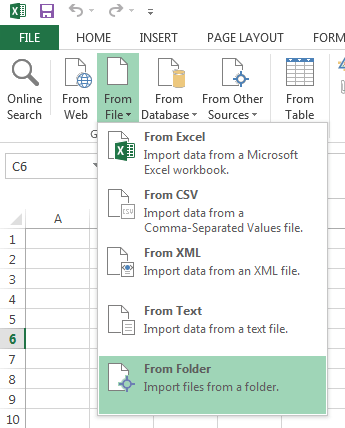
Now, the first cool thing to show about Data Explorer is that you can import and merge data from multiple files with the same structure if they’re in the same folder. With both of my files in a folder called Blog Logs, and Excel open, the first thing you need to do is to the Data Explorer tab and hit From File/From Folder:

image

The next step is to enter the name of the folder with the files in in the dialog:

image

With that done, a new Query screen appears with a list of the files in the folder:

image

You then need to hit the icon with the two down arrows and a horizontal line that I’ve highlighted in the screenshot above, next to the Content heading. This then shows the data in the files (obviously I’ve had to scrub out the sensitive data here):

image

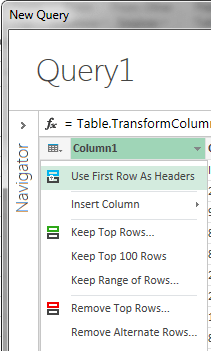
You can then use the first row as the column headers:

image

Filter the data so that the row with the second set of column headers is removed (I wonder if there’s a way to do this automatically when importing multiple csv files?) by clicking on the Date and Time column and deselecting the value “Date and Time” as shown:

image

Right-click on each column you don’t want to import (such as IP Address) and selecting Hide:

image

Right-click on the Date and Time column and select Remove Duplicates to remove any records that appear in both log files (I’m assuming that there were no cases where two people hit a page at exactly the same date and time, which of course may not be completely correct):

image

And force the Date and Time column to be treated as a Date/Time type:

image

And bingo, you’re done. Here are all the steps in the import, all of which can be edited, deleted, reordered etc:

image

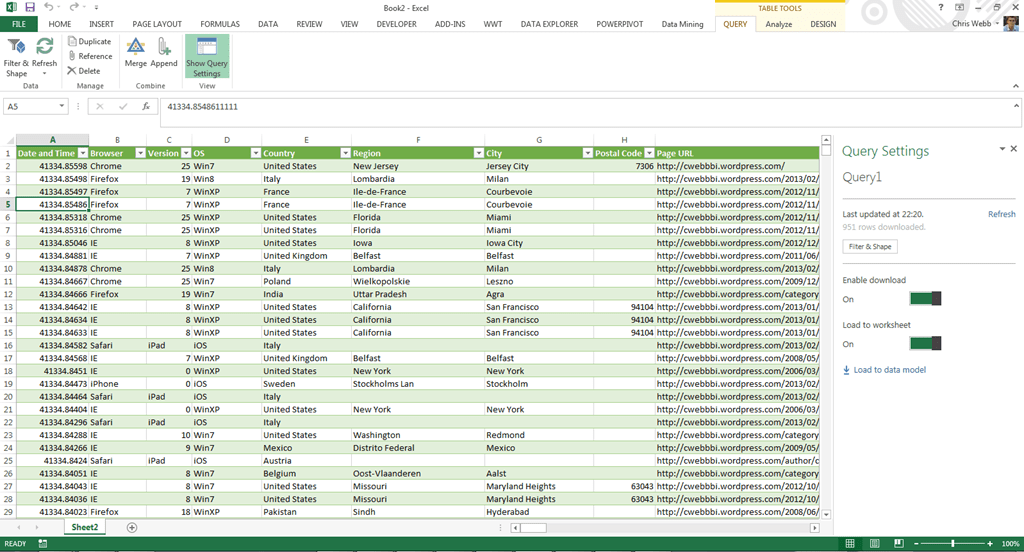
The data is then loaded into a table in a worksheet (though you can turn that off), and by clicking “Load to data model” in the Query Settings pane you can load the data into the Excel data model:

image

(NB I found some issues with loading date data into the data model and US/European date formats that I’ve reported here, but don’t forget this is beta software so there are bound to be problems like this)

You can build cool Power View reports using this data:

image

Or even explore it on a 3D map with GeoFlow:

image

Fun, isn’t it?

Public Preview of Data Explorer

The Public Preview of Data Explorer (which some of you know I’ve been following for a while, since it first appeared in SQL Azure Labs), is now available for download. You can get it here:
http://www.microsoft.com/en-us/download/details.aspx?id=36803

There’s also a good video overview here:

Data Explorer

In a nutshell, Data Explorer is self-service ETL for the Excel power user – it is to SSIS what PowerPivot is to SSAS. In my opinion it is just as important as PowerPivot for Microsoft’s self-service BI strategy.

I’ll be blogging about it in detail over the coming days (and also giving a quick demo in my PASS Business Analytics Virtual Chapter session tomorrow), but for now here’s a brief list of things it gives you over Excel’s native functionality for importing data:

  • It supports a much wider range of data sources, including Active Directory, Facebook, Wikipedia, Hive, and tables already in Excel
  • It has better functionality for data sources that are currently supported, such as the Azure Marketplace and web pages
  • It can merge data from multiple files that have the same structure in the same folder
  • It supports different types of authentication and the storing of credentials
  • It has a user-friendly, step-by-step approach to transforming, aggregating and filtering data until it’s in the form you want
  • It can load data into the worksheet or direct into the Excel model

There’s a lot to it, so download it and have a play! It’s supported on Excel 2013 and Excel 2010 SP1.

UPDATE: Check out the following blogs/links for Data Explorer:
http://blogs.msdn.com/b/dataexplorer/archive/2013/02/27/announcing-microsoft-data-explorer-preview-for-excel.aspx
http://social.msdn.microsoft.com/Forums/en-US/dataexplorer/
http://office.microsoft.com/en-us/excel-help/learn-about-data-explorer-formulas-HA104003958.aspx?CTT=5&origin=HA104003813
http://blogs.msdn.com/b/mllopis/archive/2013/02/28/get-microsoft-quot-data-explorer-quot-preview-for-excel-today.aspx

Bringing Location Information Into Excel 2013 With The WebService() Function

Last summer I wrote a post about the new WebService() function in Excel 2013 and showed how it could be used to display data from the BBC Weather web service in a worksheet. I hadn’t thought about it much after that, but the other day I was working with a customer who wanted to work out how far people had to travel to visit a location and I wondered whether this was something that could be achieved with the WebService() function. It turns out that it can be – once you’ve worked around some of the quirks of WebService() – so I thought I’d post a couple of worked examples of how to use Bing Maps and Google Maps REST APIs to solve this kind of problem in Excel.

Let’s start with Bing, because after all I’m still a Microsoft loyalist and it does get some good reviews! Before you can use the Bing Maps REST API you need to create an account key (which is free), which you can do here:
https://www.bingmapsportal.com
You’ll need to use this in all your API calls. Now, what can we do with the Bing Maps REST API? Well, lots of things as you can see here:
http://msdn.microsoft.com/en-us/library/ff701713.aspx
Geocoding (finding a latitude and longitude for an address so you can plot it on a map) is a popular thing to do, but actually in Excel it’s not so important because all of the options for mapping in Excel 2013 such as Power View, GeoFlow (Jason Thomas did a good post on it recently) and the Bing Maps Excel 2013 app, all do it for you automatically. So I decided to show how to do reverse geocoding instead – looking up an address from a given latitude and longitude – which is also possible with the Bing Locations API. Here’s how:

image

In cell C3 I have pasted my Bing Maps API key. C5 and C6 contain the latitude and longitude I want to search for. B8 contains the formula with the WebService() function that calls the API and returns the result as XML:
=WEBSERVICE("http://dev.virtualearth.net/REST/v1/Locations/" & C5 & "," & C6 & "?o=xml&key=" & C3)

C10 uses the FilterXML() function to retrieve the address from the XML:
=FILTERXML(B8, "/Response/ResourceSets/ResourceSet/Resources/Location/Name")

Easy-peasy. Another common problem is that one I mentioned earlier about calculating the distance between two points. There are a few examples out there of how to calculate direct distances (like this one I saw halfway through writing this post), but direct distances aren’t all that useful – what you really need is the time needed to drive or walk somewhere along the available roads. Bing has a web service that provides route information and it works perfectly, but I found that the WebService() function returned errors in some cases – I suspect because the XML returned by Bing was too long, but I’m not sure. Anyway, Google has a similar API (with no key needed, at least for light usage) that returns only distances and not detailed routes, and WebService() seems to like it better. Here’s an example:

image

Here, I’m entering a start address and an end address in cells C2 and C3, and then calling the Google Distance Matrix API as follows:

=WEBSERVICE("http://maps.googleapis.com/maps/api/distancematrix/xml?origins=" & ENCODEURL(C2) & "&destinations=" & ENCODEURL(C3) & "&mode=driving&sensor=false")

Then, I’m using FilterXML() to get the text of the driving distance and duration in cells C7 and C8 from the XML returned:

=FILTERXML(B5, "/DistanceMatrixResponse/row/element/distance/text")

=FILTERXML(B5, "/DistanceMatrixResponse/row/element/duration/text")

You can download a sample workbook that contains both these examples, minus my Bing Maps API key, here.

One final thing to mention is that the WebService() function seems to be horrendously slow, so you might not be able to use it to make a large number of calls very quickly, although many of these services allow you to make multiple lookups in a single API call. Also, remember that there’s usually a limit on the number of calls you can make to these APIs without paying.

MDX on Cloudera Impala

You may have seen today’s announcement (and comment from Mary-Jo Foley) on the official SQL Server blog about HortonWorks Data Platform for Windows; I won’t repeat what it says, but it’s clear Microsoft is taking Hadoop and Big Data (yuk, I hate that term, but sometimes I can’t avoid using it…) very seriously. However, yesterday I saw another, very interesting announcement from the guys at Simba that presents an alternative vision for Microsoft BI and Big Data. You can see a demo of it here:

Simba MDX Provider for Impala

There are some more details here:
https://groups.google.com/a/cloudera.org/forum/?fromgroups=#!topic/impala-user/BniN1ELYNDs

Basically, Simba have built an OLEDB for OLAP Provider that translates the MDX generated by Excel PivotTables into HiveQL queries against Cloudera Impala. You can read a good, short overview of what Impala is here:
http://blog.cloudera.com/blog/2012/10/cloudera-impala-real-time-queries-in-apache-hadoop-for-real/
and there’s more detailed information here:
https://ccp.cloudera.com/display/IMPALA10BETADOC/Impala+Frequently+Asked+Questions

In summary, what this gives you is fast, interactive analysis from within Excel going direct against large amounts of data stored via Impala, with no need for users to have to write Hive queries or stage the data in PowerPivot in the way the current Microsoft/Hortonworks solution does. Even more interesting is the fact that Simba support MDX calculated members and not just MDX queries, so given that Excel 2013 allows you to define your own calculated members you could do some very powerful analysis this way. Well, those of us who know some MDX, at least 🙂

Impala is open source and isn’t shy about the debt it owes to Google’s Dremel, which of course is available publicly now as BigQuery. When I first saw BigQuery I thought putting an MDX interface over the top would make it appealing to a much wider audience – maybe not a good thing for Microsoft, but it would be a clever move on the part of Google certainly. Microsoft hasn’t announced that it’s working on anything comparable to BigQuery, alas; already, BI tools like Tableau and BIME can connect to and query BigQuery (Tableau also connects to Amazon’s new Redshift database too), and it’s these tools that are Excel’s big competitors in the BI client tool space. I guess SSAS 2012 Tabular in DirectQuery mode going against PDW would be the only vaguely similar Microsoft solution, but PDW is on-prem only and pretty expensive. Translating MDX to the SQL used by tools like Impala, in the way that the Simba MDX Provider does, puts Excel on a more equal footing with Tableau et al. I don’t know how Simba/Cloudera will be making this MDX Provider available but I would be surprised if they didn’t charge for it; Microsoft’s close relationship with Hortonworks, a competitor to Cloudera, makes me think that Microsoft might not want to promote this particular tool either, which is a shame. Maybe an acceptable solution for MS would be to build new cartridges for SSAS 2012 and enable DirectQuery for data sources other than SQL Server? It’s unlikely to happen, I think, but it would be an option.

UPDATE: While I was writing this post, Cathy Dumas of Simba (you were wondering what happened to her, weren’t you?) also blogged about this
http://blogs.simba.com/simba_technologies_ceo_co/2013/02/demo-microsoft-excel-pivottables-on-cloudera-impala-via-simba-mdx-provider.html

Counting Consistent Customers in MDX

The post I wrote a few years ago on counting new and returning customers in MDX has proved to be one of the most popular here; it’s certainly a topic I’ve returned to a number of times for DAX, and other people (most recently Gerhard Brueckl) seem equally interested in solving this problem. However I had a comment from Sohrab Niramwalla yesterday which raised an interesting question: how do you could the number of customers who have bought from you in every time period from the beginning of time until the current date?

The Customer dimension in Adventure Works isn’t actually very good for illustrating this because customers very rarely buy more than once, but if you look at Countries then you can recreate the scenario. Consider the following query:

select
{[Measures].[Internet Sales Amount]} *
[Customer].[Country].[Country].members on 0,
[Date].[Date].[Date].members
on 1
from [Adventure Works]

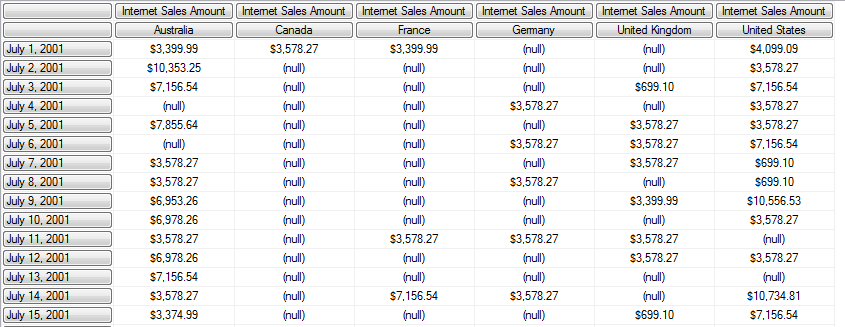
image

From the screenshot you can see that on July 1st 2001 there were purchases in 4 out of 6 countries; of those 4 countries, only 2 (Australia and USA) had purchases on July 2nd; both of those had purchases on July 3rd; but by July 4th only USA had seen purchases on every day since the beginning of time.

How then is is possible to get this count of the number of countries that have seen purchases since the beginning of time? I can think of a few approaches. One would involve using recursion and strtoset/settostr, but I generally like to avoid recursion and strtoset because performance can be unpredictable and bad. Probably the best way is to think of the problem like this: if a country has had sales on every day since the beginning of time, then count of days that had sales since the beginning of time will be the same as the total count of days since the beginning of time. Therefore, you can write a query something like this:

with
–count the number of days since the beginning of time
member measures.daycount as
count(null:[Date].[Date].currentmember)

–count the number of non empty days for sales since the beginning of time
member measures.nonemptydaycount as
count(
nonempty(
null:[Date].[Date].currentmember
, [Measures].[Internet Sales Amount])
)

–count the number of countries that have nonemptydaycount = daycount
member measures.[Consistent Customers] as
count(
filter(
[Customer].[Country].[Country].members
, measures.nonemptydaycount = measures.daycount)
)
select measures.[Consistent Customers] on 0,
head([Date].[Date].[Date].members, 15) on 1
from [Adventure Works]

image

Mosha’s technique for optimising count(filter()) calculations might also be useful here, although I have to admit I’ve not tested it to see if it does improve performance.

However, for those of you who are fans of obscure MDX, here’s another solution:

with
member measures.[Consistent Customers] as
count(
–iterate over every date since the beginning of time
generate(
{null : {{[Date].[Date].currentmember} as currentdate}.item(0)}
,
{
–if the current date in the iteration is the first date
iif([Date].[Date].currentmember is [Date].[Date].[Date].members.item(0)
,
–then define the inline named set customerset as
–all the nonempty customers
intersect(
nonempty(
[Customer].[Country].[Country].members
, [Measures].[Internet Sales Amount]) as customerset
, {})
,
–else, redefine the set customerset as the intersection of
–customerset and the nonempty countries in the current time period
intersect(
intersect(
customerset
, nonempty(
[Customer].[Country].[Country].members
, [Measures].[Internet Sales Amount])
) as customerset
, {})
)
–note that the intersect function is used to ensure only an empty
–set is ever returned from these expressions
,
–if the current date in the iteration is the current time period
–ie we are at the final iteration
iif([Date].[Date].currentmember is currentdate.item(0)
–then return the contents of the named set customerset
, customerset
, {})
}
))

select {measures.[Consistent Customers]} on 0,
head(
[Date].[Date].[Date].members
, 15)
on 1
from [Adventure Works]


It uses the generate() function to loop over ever date from the beginning of time to the current time period, and then redefines an inline named set (called customerset) on every step of the iteration to find the non empty countries. It doesn’t perform as well as the previous solution in this particular case, but if there were more countries that might change; a few tweaks to the code might also speed it up. I thought it was worth mentioning, though, for the novelty value.

DatabaseDays SQL Server Conference in Switzerland

Apart from all the public training courses I’m running in London this year, I’m also going to be running pre-conference seminars (as well as speaking) at SQL Server conferences outside the UK. The first of these will be at the DatabaseDays conference in Switzerland, which will be taking place at the Trafo Conference Centre in Baden, not far from Zurich, on the 17th-19th April. My pre-conference seminar will be a one-day Introduction to MDX,  and other speakers at the conference include Jen Stirrup, Stacia Misner and various members of the SQLCat team; you can see the the full list of conference sessions here. I love visiting Switzerland (I lived there for a few years a while back) so I’m really looking forward to it!